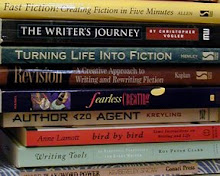
I was thrilled to have a visit on my blog from a writing mentor, Ken Atchity, who authored A Writer's Time, one of the textbooks used in my book-structuring classes.
Ken introduced me to the concept of writing in "islands," which makes use of random as well as linear structuring.
If you haven't come across A Writer's Time, be sure to get a copy and read the first five chapters. It'll open your eyes to a brilliant method to organize a new book idea.
Visit Ken's blog for a great post by Garrison Keillor. http://kenatchity.blogspot.com
Tuesday, February 3, 2009


How to Create Writing Voice? Natalie Goldberg Says to Ask, What Brings You to Your Knees? What Do You Love with Your Whole Heart?

In her book, Thunder and Lightning, free-writing expert Natalie Goldberg describes a writing exercise she created after reading Borrowed Time by Paul Monette. Borrowed Time is a memoir of Monette's experience with AIDS.
When one of her students commented that AIDS gave Monette his voice as a writer, Goldberg realized that voice is created when "something crosses our lives, brings us to our knees."
His partner's diagnosis of AIDS brought Monette to his knees, and Goldberg writes, "All this cut across his throat and released his voice."
So Goldberg asked her class two questions: What has brought you to your knees? What do you love with your whole heart?
How do we mature as writers, develop our voice? Goldberg proposes that some combination of deep love and aching loss brings us to this place where we deliver story in some unique way. We become different, not only in what we say but how we choose to say it. What we omit, what we focus on.
What loss has come into your life? Make a list. See how it has shaped you.
Now list any gifts that came from these losses. What do you love with your whole heart, without reservation?
If you haven't read Goldberg's Thunder and Lightning, get a copy. If you want to explore the origins of your own creative voice, try these two questions this week. Watch how your writing changes.
When one of her students commented that AIDS gave Monette his voice as a writer, Goldberg realized that voice is created when "something crosses our lives, brings us to our knees."
His partner's diagnosis of AIDS brought Monette to his knees, and Goldberg writes, "All this cut across his throat and released his voice."
So Goldberg asked her class two questions: What has brought you to your knees? What do you love with your whole heart?
How do we mature as writers, develop our voice? Goldberg proposes that some combination of deep love and aching loss brings us to this place where we deliver story in some unique way. We become different, not only in what we say but how we choose to say it. What we omit, what we focus on.
What loss has come into your life? Make a list. See how it has shaped you.
Now list any gifts that came from these losses. What do you love with your whole heart, without reservation?
If you haven't read Goldberg's Thunder and Lightning, get a copy. If you want to explore the origins of your own creative voice, try these two questions this week. Watch how your writing changes.
Tuesday, January 27, 2009
Show, Don't Tell--What Does That Really Mean?
 Imagine trying to describe the image to the left. Lights swirling all over a black background? Winter wheat in a field, caught by the last sun?
 What could possibly convey the movement and delicacy of this photograph to someone who hasn't seen it? That's basically what we writers are up against. We're trying to convey the emotional truth of a moment to readers who've never been there.
Some writers do this by telling about the moment. "She was depressed after he died." "He never felt so excited." But this telling doesn't really put us, the reader, in that moment. We're still observing from a distance. When you translate telling into showing, the reader comes into the same room with the story.
"She was depressed after he died" becomes "One day Mollie drew the curtains on the daylight and did not ever draw them back again" (William Trevor, "At Olivehill" from Cheating at Canasta). "He never felt so excited" becomes "His skin was now flushed, his eyes sparking. He leaned into the provocation" (Vivian Gornick, "At the University" from Approaching Eye Level).
See the difference? It's great writing, but why? Because it places us there, with the people in the story, not telling but showing.
This week find a passage, a sentence, a phrase where you backed off, out of the room of your story. Bring yourself and your reader back. Translate the telling into showing.
PS Go out and find the two books mentioned above. Fabulous writing, great winter reading.
Tuesday, January 20, 2009
Winter Writing--A Chance to Slow Way Down
 Outside my office window, the snow is coming down fast. I cancelled a dentist appointment today, shoveled the steps, walked to the mailbox, but mostly I'm reveling in being snowbound. It gives me no excuse not to slow down.
 Slowing down is great for my writing. A naturally speedy person, I tend to get bored with passages where I should linger longer. So I use snow to lull my fast-paced mind into that drifty dreamy place my characters often need.
What slows you down? We're not talking coma level, just slowed to the place where you appreciate--and can write--the finer details. This week's exercise will help you notice how your book comes alive in the small things that you might notice more as you slow your pace.
1. Put on some music that lets you drift.
2. Don't look at emails, Facebook, or My Space for 20 minutes--force yourself!
3. Look around the room you're in. Begin noting what you see.
4. Then pay attention to sounds. Note what you hear.
5. If you can, add temperature and texture--the touch sense. Or smell.
6. Do this while breathing. Deeply if you can.
What's the difference in your writing?
Tuesday, January 13, 2009
Reverse Goal-Setting: Magic Action for Writers

Goal-setting doesn't work for many book writers. Maybe we're too random. Maybe we need more flexibility than traditional goal-setting allows. Even those of us who love lists rebel three months into a prescribed plan. Our books are evolving in a new way, and the plan doesn't fit.
Enter Reverse Goal-Setting. With Reverse Goal-Setting, you start from the end and work backwards. You get flexibility. You get chances to adjust and modify as you go. You also get a reality check--and you create writing goals that are actually possible to achieve and still stay sane and happy in your larger life arena (with family, friends, work responsibilities).
Want to try it? Using the presume you did last week (see post below this one) you can launch your Reverse Goal-Setting pretty easily. If you didn't do last week's exercise, take time to do it now (10 minutes max) then come back.
Get a large sheet of paper. Create 12 columns or boxes, one for each month of 2009. Label them by the months, from January to December.
Starting with December's column, review your year-end goal from your presume. Ask yourself: What would have to happen in December for this January 2010 goal to be realized? Write three tasks for December 2009.
Move back one month to November 2009. What would have to happen in November for December's goal to be realized? Write three tasks for November.
And so forth. You get the picture. Continue backwards through the months until you get to now, January 2009.
Here comes the reality check. Look at where you are now, with your writing in its present state, with your other responsibilities. Is your year-end goal reasonable, even possible? Is it too big or too small? Does it feel good, well aligned with your other creative goals and your life responsibilities?
Modify, add, reduce, adjust as needed, until the year-end goal in your presume feels accurate and just enough of a stretch.
I learned this the hard way: Success in goal-setting is all about being accurate. It's also about adjusting the goal so you can succeed. Each time you succeed, your self-esteem as a creative person goes way up. Using Reverse Goal-Setting makes it easier to see where you're going to succeed with your writing goals--and where you're not.
Enter Reverse Goal-Setting. With Reverse Goal-Setting, you start from the end and work backwards. You get flexibility. You get chances to adjust and modify as you go. You also get a reality check--and you create writing goals that are actually possible to achieve and still stay sane and happy in your larger life arena (with family, friends, work responsibilities).
Want to try it? Using the presume you did last week (see post below this one) you can launch your Reverse Goal-Setting pretty easily. If you didn't do last week's exercise, take time to do it now (10 minutes max) then come back.
Get a large sheet of paper. Create 12 columns or boxes, one for each month of 2009. Label them by the months, from January to December.
Starting with December's column, review your year-end goal from your presume. Ask yourself: What would have to happen in December for this January 2010 goal to be realized? Write three tasks for December 2009.
Move back one month to November 2009. What would have to happen in November for December's goal to be realized? Write three tasks for November.
And so forth. You get the picture. Continue backwards through the months until you get to now, January 2009.
Here comes the reality check. Look at where you are now, with your writing in its present state, with your other responsibilities. Is your year-end goal reasonable, even possible? Is it too big or too small? Does it feel good, well aligned with your other creative goals and your life responsibilities?
Modify, add, reduce, adjust as needed, until the year-end goal in your presume feels accurate and just enough of a stretch.
I learned this the hard way: Success in goal-setting is all about being accurate. It's also about adjusting the goal so you can succeed. Each time you succeed, your self-esteem as a creative person goes way up. Using Reverse Goal-Setting makes it easier to see where you're going to succeed with your writing goals--and where you're not.
Tuesday, January 6, 2009
New Year's Treat--A Presume Exercise for Writers
What's your dream for your book this year? Try a simple new-year's exercise to find out. It's called a presume--a word coined by Tony Fanning and Robbie Fanning, authors of a fabulous book called Get It All Done and Still Be Human, which changed my life when I read it twenty years ago. As clearly as a resume shows your past, a presume shows your future. You are using a principle called "acting as if." Believe me, it works!
Want to try it? Imagine yourself a year from today. Write the date at the top of your page: January 6, 2010.
Now, writing in the present tense, compose a few sentences about where you are with your writing on that date. "I am..." "I have completed..." "I finally discovered..." Use these excerpts from students in my creative-writing workshops if you need clues:
Scott: "It's New Year's Day and I just printed out the complete first draft of my novel! All because I finally got a handle on the important characters. They're coming alive, it's totally exciting. I even know--I think!--where to take them next."
Martha: "This year has been good for my writing in that I finally understand what this book is about. By February, I worked out a regular writing schedule, which I kept to more or less, and B. and the kids have been very supportive."
Celeste: "After some deep thinking, I realized I needed a break from the book and took a couple of really outstanding poetry classes. They re-energized me creatively. I'm back at work on the manuscript but it's not a burden."
What would have to happen, both professionally and personally, for you to feel completely happy with your writing progress this coming year? Write your presume any way you wish--as a business card, a poem, a journal entry, a list of items. Put it away and let it work its magic.
Next week, we'll look at action steps to make the presume real, a technique called Reverse Goal-Setting.
 It's called a presume--a word coined by Tony Fanning and Robbie Fanning, authors of a fabulous book called Get It All Done and Still Be Human, which changed my life when I read it twenty years ago. As clearly as a resume shows your past, a presume shows your future. You are using a principle called "acting as if." Believe me, it works!
Want to try it? Imagine yourself a year from today. Write the date at the top of your page: January 6, 2010.
Now, writing in the present tense, compose a few sentences about where you are with your writing on that date. "I am..." "I have completed..." "I finally discovered..." Use these excerpts from students in my creative-writing workshops if you need clues:
Scott: "It's New Year's Day and I just printed out the complete first draft of my novel! All because I finally got a handle on the important characters. They're coming alive, it's totally exciting. I even know--I think!--where to take them next."
Martha: "This year has been good for my writing in that I finally understand what this book is about. By February, I worked out a regular writing schedule, which I kept to more or less, and B. and the kids have been very supportive."
Celeste: "After some deep thinking, I realized I needed a break from the book and took a couple of really outstanding poetry classes. They re-energized me creatively. I'm back at work on the manuscript but it's not a burden."
What would have to happen, both professionally and personally, for you to feel completely happy with your writing progress this coming year? Write your presume any way you wish--as a business card, a poem, a journal entry, a list of items. Put it away and let it work its magic.
Next week, we'll look at action steps to make the presume real, a technique called Reverse Goal-Setting.
Tuesday, December 30, 2008
Do Some Great Research--On Your Characters!

Your book has a major and minor cast, whether you're writing fiction, memoir, or nonfiction. People move stories, illustrate theories and ideas, and rumble in the background of all great literature. It's up to you, the writer, to get to know them.
This week, interview your main players. Find out some important details about them. You can start with the questions below, which I use whenever I need to get deeper into my story and the motivation of my players.
1. What’s your height, weight, eye color, hair color?
2. What do you like or dislike about your looks?
3. How old are you really?
4. How do you feel about your age?
5. What three things are in your refrigerator?
6. What sort of work do you do?
2. What do you like or dislike about your looks?
3. How old are you really?
4. How do you feel about your age?
5. What three things are in your refrigerator?
6. What sort of work do you do?
7. What’s your favorite possession?
Just take good notes. Be a researcher for your own book. You might learn some new things!
Tuesday, December 23, 2008
Disguises and Masks: A Great Way to Understand and Uncover Your Book's Characters
What's behind the veil? If everyone in literature wears a disguise or mask that veils their true self, what are your book's major players hiding behind?
This week's writing exercise asks you to unmask these folks through a series of nitty-gritty questions. Spend about 20-30 minutes on this exercise, if you can. Be prepared to dig and learn!
Pick one of your characters and write an answer to one of these questions, as if you were interviewing them.
1. What broke your heart?
2. What do people who know you think of you?
3. Who would you eliminate from your life?
4. What do you wish never happened to you?
Monday, December 15, 2008
Mixing Things Up--A Recipe to Break the Block

Alison McGhee, writing instructor and author of many wonderful novels including Shadow Baby, once taught a very effective exercise in a writing class I attended. She had three lists on the whiteboard: people, different ages (such as 13 year old, 2 year old), and different objects. She asked us to choose one from each list and write a scene.
I loved it. It led to the pivotal theme for my new novel, Qualities of Light, which will be published in 2009 by Spinsters Ink.
Here's an adaptation of Alison's idea. You can try it this week, if you want. It's very effective for getting out of a writing rut.
Set a timer for 20 minutes. Write a scene that takes place in one of these places:
in a bus stop shelter in downtown Minneapolis
at O'Hare's airport security
streetside cafe in Gordes, France
laundromat in Gillette, Wyoming
riverside picnic area
Where there's an argument about one of these objects:
penknife
silver coin
piece of sea glass
diaper
cell phone that doesn't work
Mix them up--one from each list--and see what happens!
Tuesday, December 9, 2008
A Great Exercise from Listen to Me's Lynn Lauber
In her excellent book on writing craft, Listen to Me, memoirist Lynn Lauber writes: "If you find yourself telling the same story over and over, but in a way you don't find satisfying, try changing person or point of view."
I've used this technique to get a new viewpoint on my characters, especially when I feel the icy chill of writer's block.
Try it right now. Take a story you know well, from your life or your writing, and tell it from  someone else's point of view. Tell it anew, seen from your dog's eyes. Or your grandfather's. Or, instead of the fictional character Jason's, try his partner Monique's. Write for 20 minutes or two pages' worth. See what happens when you break out of the known voice or view.
 someone else's point of view. Tell it anew, seen from your dog's eyes. Or your grandfather's. Or, instead of the fictional character Jason's, try his partner Monique's. Write for 20 minutes or two pages' worth. See what happens when you break out of the known voice or view.
Can you catch a new image of where the writing could go from here?
Subscribe to:
Posts (Atom)


 Posts
Posts