Tuesday, July 22, 2008

Writing Exercise of the Week


Imagine a year from today. Write about your book, in the present tense, using as much detail as possible, with as much loving attention as you can muster.

What would you like to have happen with your book, by then? What dreams could you imagine being fulfilled?
How clearly can you imagine it?

Sunday, July 20, 2008

Do You Have Book-Writer's Block?

Do you relate to this question, from reader Eleni Turner? "Please write about writer's block--I'm currently suffering from lack of inspiration on the storyline I'm most serious about. I know exactly what I want to write, but when I try, it becomes either too boring or too rambly."

What's your best technique for handling writer's block?
Is it real? (Some writers poo-poo the idea, but those of us who have experienced it might say otherwise.)
What makes writer's block visit you--and what makes it finally leave?


Post your ideas, tips, and suggestions below.

Thursday, July 17, 2008

Jane Levin's New Poetry Chapbook


Jane Levin's new poetry chapbook, Legacy, has just been published. Jane was a student in my writing classes and began publishing her poetry with great success.

This is her first book. Congratulations, Jane! I've reviewed her book in The Alsop Review. To read this article (and some great poetry), click here.

Tuesday, July 15, 2008

Writing Exercise of the Week

Begin a dialogue on paper with an aspect of your book that you dislike or don't "get" or can't move forward with. A reticent character? A chapter that won't come together? Something you just can't write, no matter how hard you try?

Ask it why it is in your book--and your life. Write down whatever comes as an answer.

Thursday, July 10, 2008

Writing When You're Traveling--How Do Book-Writers Do It?

So far it's been a summer of intense travel, living out of a suitcase, and trying to write in internet cafes, sending book chapters-in-progress to myself by email.

Each trip, I try not to leave behind these books I'm writing. A colleague once said, if you stop writing for three days you have to start over again. I get that. Losing the flow of my characters' voices, losing the ideas of how to structure a section of my book just so. Does this happen to you? Or can you "hold" the book for longer in your head without showing up on the page?

How does travel affect your creative life? How do you keep going with your book-writing when you're on the go?

Post a comment by clicking below--let us know!

Tuesday, July 8, 2008

Get Those Ducks Moving! A Poem-Writing Exercise of the Week for Book Writers


Step 1: Create one sentence for each of four plot points in your book (peak moments, external movement, change).
Step 2: Create one sentence for each of four different character’s shifts (internal change in the character, realization moment).
Step 3: Create one sentence for each of four different setting details (with something from the five senses associated with each).
Step 4: Create one sentence for each of four objects or memories associated with the book.
Step 5: Find one musical detail in the book (sound or rhythm).

Take all the above musings and write a four-stanza poem about your book. Use one plot point, one character shift, one object or memory in each stanza. Then try to get something rhythmic or musical in each stanza.

Thanks to Stuart Dybek's interview in Novel Voices (edited by Jennifer Levasseur and Kevin Rabalais) for the inspiration for this exercise. My book-writing class loved it!

Friday, July 4, 2008

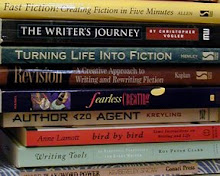
Fabulous Writing Books to Help You Write a Book

Vivian Gornick talks about “the situation and the story”—the two elements of good prose. What happens and why it happens. Because of her simplicity in describing this complex idea, The Situation and the Story became one of the truly influential writing books in my life.

Carol Bly’s The Passionate, Accurate Writer taught me about writing of consequence and how to stay unembittered while working with difficult material. Kenneth Atchity’s innovative book-gathering ideas in A Writer’s Time transformed the last five manuscripts I completed and published.

For years, I whole-heartedly recommended these three books to my writing buddies, coaching clients, and students. I know there are many very good writing books available—and shelves of them line my office—but only a few, such as these, have really taught me how to grow as a writer.

A friend’s discovery recently added another transformative writing book to my small collection. From Where You Dream, by Robert Owen Butler (Grove/Atlantic, Inc., 2005) is a series of lectures to his graduate fiction students, transcribed and edited by Janet Burroway (of Writing Fiction fame).

Although geared toward fiction writers, From Where You Dream answered my question on how to bring out the deeper meaning of any piece of writing, especially when writing a book.

Tuesday, July 1, 2008

Exercise of the Week for Book Writers

Here are some questions to think about, as you work on your writing and your book this week:

What kind of reader do you see in your mind's eye or heart, as you write: Women over fifty? Boys under fifteen? Guys who love fishing?

Is your language, tone, and style going to engage this particular reader?

Is the pace of your narrative (how fast it moves) going to make them want to read more? Or will it make them stop reading?

Most book writers think all they have to do it is write. Why consider these questions at all? These days, if you’re thinking of being published (or if you want your book to be read by more than four or five of your close friends or family), you have to make people want to turn the page.

You have to consider the reader.
The agent will.
The publisher will.

This week, spend a little time making notes about your reader. Really think about how best to serve them, while keeping your own vision about your book.

Sunday, June 29, 2008

Tuning Your Ears--First Step in Developing the Right Pacing for Your Book

My first visit to the Metropolitan Opera in New York City, I saw Puccini’s Turandot. There wasn’t a moment during Puccini’s music or story when my attention wandered.

That’s exactly what good pacing does. It doesn’t let the reader wander.

Start tuning your writer’s ears by re-reading books you love. Pick three in the genre of your book.

● To study how the writers deliver information—where the pacing is fast, where it is slow—hold two pages up, squint at them, and see the balance of white space to text. Conversation sections have more white space, description has less. So conversation (dialogue) usually equals faster pace, and description (summary) equals slower pace.

● Study the pacing at the end of a suspenseful or exciting chapter in one of these favorite books. How short are the sentences? Are the verbs particularly vivid?

● How does the writer transition to the next chapter’s opening paragraph? Is there a change in pace (usually, there is—so the reader can take a breath)?

● Read two pages aloud. What rhythm do you perceive? Is it fast or slow? Where does it vary?

● Look at the internal parts of the writing—what is being revealed by the author when the pacing is slow? Is it an emotional moment where the author might want us to linger? When the pacing is fast, is an event happening that’s very tense? Is there a slower-paced section later in the chapter, where the meaning of the event is presented?

● Practice writing fast-paced scenes to fast-paced music, slow scenes to dreamy music. How does your understanding of pace change as your writing changes?

Wednesday, June 25, 2008

Bits and Pieces--Is That OK?

Is this how you are feeling about your writing sometimes? Like you're in a forest of bits and pieces where nothing makes sense enough to be a book?

A reader wrote me about this common dilemma: " I feel like a have a big mess!" she said. "I like what I have written, but I don't know how to add to it at this point. I'm constantly thinking about writing. Constantly putting it off. My question is.....is it okay to keep writing this way? Is it okay to have bits and pieces? Do writers of memoirs (etc.) ever give a handful of pages to a 'writer' or editor to be written? Do/can these writers work together to create a wonderful story?"

Making Sense of the Mess
Many writers in my classes encounter this. It's very normal. The random part of you might love the bits and pieces you are producing, but the linear part wants it all to look like Something Good. It's the time-honored struggle between the two creative sides of ourselves. The trick is to acknowledge both as useful, and know when to switch.

If you get that itchy feeling that there is too much mess, it's time for some structuring. My favorite is the storyboard. Used in film production, a storyboard is a giant blank cartoon--boxes waiting to be filled with steps of your story.

So here's what you do:
1. Give a title to 10 of the bits and pieces you've written. You can do more if you want--eventually, you'll do them all but this is a nonthreatening way to get your feet wet.
2. Draw a storyboard on a large piece of butcher paper. Just create blank boxes, row after row, until you have 10 or more.
3. Look at your list of titles. Imagine how they might logically or intuitively be placed on the storyboard. What order could they go?
4. Write one title per box.

This is a very basic storyboard. What does it do? It begins to calm that frustrated part of you that wants to see progress and order in your book writing journey. It begins to show you what might be missing--what you still need to write about, are avoiding writing about, have written about too much and avoided other areas more vital.

Let me know what you think, or if you have more questions. Please post your comments by clicking the little envelope below.