Friday, February 21, 2014

Winter Doldrums? Ten Fun Exercises to Get Going on Your Writing Again!

If you have the book blahs this week, if the Inner Critic is loud in your ear and heavy on your shoulder, try one of these favorite jump-starters.  
 
They all work.  
 
Most take ten minutes or less--about the time it takes to walk into Starbucks and order a latte. 

Ten Fun Exercises
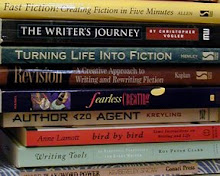
1.  Write down your book's working title.  Play with this, have fun.  For inspiration, browse a bookstore or your home library shelves.  You'll begin to feel more focused.

2.  Write five reasons you're writing this book.   You'll remember your passion for the topic, place, characters, or plot.

3.  Write down your chapter titles--even if you're not sure you'll have chapter titles.  You'll tap into the vision of the bigger project.

4.  Make up three blurbs for your back cover.  Imagine asking one of your favorite reviewers or writers to do this--and they say yes.  What might they say?  You'll start realizing this book is worth praise!

5.  Design your book cover.  Use a pen and paper, a graphics program, or go for it with Photoshop.  What colors, designs, images best express your book?  Seeing your book cover mock-up will inspire you.

6.   Get out file folders or open Scrivener or another organizing software.  Create sections for your book--start with the three acts, or major divisions.  Then move into chapters, then into scenes or islands.  Gather your research, ideas, and writing into these sections.  You'll feel very organized! 

7.  Write down three ways your book might affect someone's life.  Would it get them moving on a change?  Would it inspire them or help them know they're not alone?  Would it present new ideas and education?  Would it carry them into a wonderful story?  You'll get more in touch with your reader, who can support you through the journey of writing a book.

8.  Write your premise statement.  See the post below from February 7 for how to.  You'll have an instant "elevator speech" or agent pitch.

9.  If you've been working on this for a while, print out everything you have so far.  You'll be amazed at how much there is--and how far you've come since you started.

10.  Email three writing friends.  Ask them to each tell you one thing they absolutely love about your writing.  Print these out and post them on your writing wall.  You'll remind yourself that you have support and you'll keep going!

Friday, February 14, 2014

What Do You Love about Your Book? A Simple Writing Exercise to Fall in Love with Your Creativity Again


I recently received a wealth of feedback on my novel revision.  I sought this, from other published writers and good readers.  I'd worked hard to get to the point where my manuscript was ready for another round.

The comments came in, and they were excellent.  My readers took time to really think about the story, especially its complicated structure.  Where did they fall into the "dream" of the book?  Where did they fall out, get distracted or confused?  I took all the pages, the emails, and I made a master list.  These were the areas to look at more closely.  Where I hadn't quite delivered what I wanted.

Of course, with feedback, especially feedback in quantity, there are some rules to keep your sanity.  Extreme likes or dislikes are suspect.  Opposing views cancel each other out.  You look for repeating comments.  What many people noticed is often worth your notice.

Friday, February 7, 2014

Writing a Premise Statement for Your Book: Inner and Outer Story Synopsis and Why It Helps Get You Published

Imagine receiving 300-400 manuscript queries--each week!  Flooding your inbox.  Some weeks, even more.   

Welcome to the life of agents.  And their hired assistants who sort through queries to find the lucky few that stand out.  Maybe you'd like it to be yours?  What would you have to do, to make that a possibility?

Writers working on their first book may not even know what a query is.  It's a short, one-page letter (via email, often) that presents your book in the most engaging way.  It goes like this:  one paragraph about your book, one about your credentials for writing it, one about why you chose to solicit this particular agent.  It's brief, it's punchy, it's eye-catching. 

At least, that's the plan.

How do you start writing a good query? 

With a premise statement, also called a tag line or pitch or elevator speech.  A quick synopsis of your book's inner and outer story.

Friday, January 31, 2014

Carrie and Alton Barron on "The Creativity Cure"--An Interview with Two Clinicians about Their New Book

Carrie and Alton Barron are two physicians, well known in their respective fields of psychiatry and orthopedic medicine.  Carrie is on the faculty of Columbia College of Physicians and Surgeons and Aldon is recent past president of the New York Society for Surgery of the Hand and a long-time orthopedic surgeon for the NY Philharmonic Orchestra.  I had the pleasure of meeting Carrie when she began attending writing classes with me at the Hudson Valley Writers' Center in New York's Westchester County--and Alton some months later.  Passionate about creativity and its power for healing, their new book, The Creativity Cure (Scribners, 2012), is garnering rave reviews. 

This week, they share some of the process of writing a nonfiction book, staying passionate about their subject during the long journey, and what happens when it gets published.


When did you begin writing this book?  What were the stumbling points and the Ah-ha! moments that you remember?

Friday, January 24, 2014

Check Out The Write Life's List of 100 Best Websites for Writers--We're Included!


This is one of the best collections of writing websites I've seen.  Spend some time enjoying it.  (We're thrilled to be included.  Some heavy hitters in this line up and lots of excellent and inspiring stuff.) 

Click here to visit.

Friday, January 17, 2014

How Writers Reveal a Character through "Container"--The Environment of a Story

A memoirist was trying to write about the sadness she felt at her father’s death.  Her writer’s group gave her unexpected feedback:  while it was clear she was very sad, when they heard her speak of his death, her feelings on the page were abstract, hard to really grasp. 

“They don’t feel any of the sadness I feel,” she told me.  She cried when she wrote, so this confused her.  

When I read the chapter in our next online class together, I too noticed how distant the writing felt.  My take-away was an almost-intellectual sorrow, a wistfulness, rather than any strong emotion.

A very intelligent woman, this writer worked as a psychologist.  She knew people, she understood how they ticked.  But she hid her “character,” herself, behind her thoughtful prose, rather than revealing it. 

Friday, January 10, 2014

Patterns of Change--How Do You Create Strong Conflict in Your Fiction or Memoir?

Most stories foster change.  Either change in the situation, in the character or narrator, or in the reader and their understanding of a topic.


Most writers know that change in story comes from conflict.  Conflict is a dilemma presented to a person and it forces action.  It makes a person realize a truth, right a wrong, change behavior or thoughts, move to a new city or job or relationship, do something different. 

Friday, January 3, 2014

Making Your Own Book Trailer--Guest Blog by Authors Juliann Rich and Aren Sabers

You've seen them:  short, sassy movies, using imagery, themes or even text from a soon-to-be-published book.  A moving visual image to entice you--the reader--to purchase that book.  

Book trailers have come out in the last decade.  From novelty item to common device used by publishers and authors to pique interest, generate web presence and platform.  Even used in school classrooms by teachers to entice reluctant readers or prompt discussion, designed by students as part of arts-and-communications curricula.

Are you excited about making a book trailer?  Authors Juliann Rich and Aren Sabers, creators of their own successful book trailers, share their best tips in this guest blog.  Their websites and trailers are listed at the end of their post--be sure to check them out.  Fun, entertaining, and moving--and hopefully offering excellent reasons to read their new books!

Friday, December 27, 2013

How'd You Do? Reviewing Your Year's Writing Goals--A Sure Way to Encourage Your Creative Spirit

Each month, I set goals with a writing partner who lives in another state; we used to be in the same writing group until I moved, and I value her feedback so we set up a monthly exchange by email or phone.  We look at what we've accomplished or learned in the previous month and think about what's next.

We also like to do this each December or January, reviewing our goals for the past year and thinking about how it went.  And what we want to bring into manifestation next.

Accountability is hard to come by.  It's easy to let writing slide to a back burner, rather than generating creative heat in your life.  These regular check-ins help me stay accountable. 

But they also show me--much to my own surprise--how much I actually grow as a writer!

Friday, December 20, 2013

Your Writing Voice: How to Develop It, Recognize It, Not Copy Someone Else's

One of my long-time students asked a great question this week:  how does a writer develop voice?  Voice is the elusive uniqueness that comes out in writing over time, the signature of the individual wordsmith.  We would never mistake a passage by Flannery O'Connor with one by Gabriel Garcia Marquez. 

What makes them different, distinctive? Each delightful in its own way?  That's voice.

The elusive hunt for voice is much discussed in writing books, classes, MFA programs.  One of