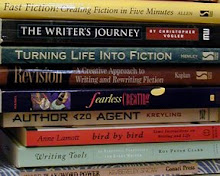
This week, check out this interview with Burroway about her new memoir, and the intricacies of her writing process--the how, where, when of writing books.
Friday, May 2, 2014
Wisdom from Janet Burroway, Author of Writing Fiction: A Guide to Narrative Craft
I came across Janet Burroway's superb text on writing fiction during my MFA program. Writing Fiction: A Guide to Narrative Craft is the most widely used textbook for fiction MFAW programs; clearly, Burroway knows her craft and knows how to teach it.
This week, check out this interview with Burroway about her new memoir, and the intricacies of her writing process--the how, where, when of writing books.
This week, check out this interview with Burroway about her new memoir, and the intricacies of her writing process--the how, where, when of writing books.


Friday, April 25, 2014
Finding the Edges: The Art of Theme and Voice in Fiction and Memoir

Most writing teachers say theme and voice are impossible to teach. The art of them (for it is more art than craft, with these two) must be caught.
I agree--and disagree.
As a writing teacher since the early eighties, I've practiced techniques to bring out meaning (theme) and allow natural strengths and uniqueness (voice) to emerge on the page. Techniques train the creative self to sink into receptive, listening mode. Techniques can alert you to what makes good meaning, how to ask for insight from others who may see it more clearly, and how to make room in your writing process to listen. Voice is what comes as you become more of yourself on the page, reveal more, embrace vulnerability.
Both are all about letting go rather than pushing ahead. What allows you to let go the easiest? And still keep writing . . .
When I was asked to teach a one-day workshop on "The Art of Voice and Theme in Fiction and Memoir" for the Loft Literary Center in Minneapolis this summer, I began researching more fervently--how do other writers do this? My workshop will be on Saturday, July 19 (click here for more information), and I have some time to develop it. But as luck would have it, insights began coming across my desk.
Finding theme, or meaning, means limiting focus. It sounds contradictory, but once you figure out what your book is about--which may connect with a place, an era, a relationship, or an event--you have something to write against. As you write against this edge, you learn what is and what is not your story. This seems, in my experience, to be the great doorway to theme and voice.
It feels counter-intuitive, yes. We imagine that theme is about stretching wide and opening up, that more meaning comes from letting in greater ideas. There is an aspect of expansion in theme development, but it's when we figure out what the story is really about, that theme begins to emerge.
Theme is meaning. One of the exercises I give to my advanced online book-structuring classes is to write about what their book means to them. What does it really mean to you, the writer? Then write about the possible take-away for the reader. Somewhere between these, theme or meaning often lies.
A great insight came from reading Dani Shapiro's new book, Still Writing. Dani has a chapter called "Edges," where she cites a writer named Joshua Cody, author of the memoir, Sic. Cody says, "the key to any composition, it occurs to me, is to write against an edge, a frame." Cody is a cancer patient, and for him, cancer is the frame he works with. "Put a frame around something, anything--the frame of cancer, say, around a life, and you've already gotten somewhere without willing it." Shapiro adds, "writing against an edge . . . can be enormously helpful in giving you clarity about your particular corner of the crazy-quilt. Your patch of land. Your precise and unique bit of geography. Your world."
Your Weekly Writing Exercise
1. Ask yourself about the edges or frame of your book-in-progress. Is your frame, or edge, nature or the wilderness, a certain relationship, coming of age or childhood, mental illness, cancer, disfigurement, rape or abuse, a serious illness such as AIDS or MS, the workings of tall clocks, sailing, a thru-hike? What's the frame "through which you can see you story" and what edges or boundaries does it provide?
2. Freewrite about this frame. Decide, if you find more than one edge or frame, which is the most vital to you, to your story, if you had to choose just one.
Friday, April 18, 2014
Organizing Your Book: Great Tips on What to Save, How to File It to Find It, and More!

"Help!"
she wrote, "I'm swimming in paper and computer files. How do I
organize this mess, know what to keep and what to toss, and navigate the
rest?"
In
my book-structuring classes, we mostly deal with the art and craft of
writing, but this question always comes up. Writing a book is a
long-term relationship between a writer and a lot of words. It's not
like one piece of paper, or even one notebook. More like a marriage
than a one-night fling. It pays to be prepared for the onslaught.
I
use a couple of tried-and-true techniques for keeping track of my book
as it moves from idea to chapters to first draft to multiple revision.
I've also gathered good tips from other published writers. Here's the
ten top tips--in no particular order of importance.
Maybe one or two will help Sharon--and you--keep afloat.
1. Work with both a writer's notebook (for ideas, jottings, images, and freewrites) as well as a computer. Some writers I interviewed used the computer for initial ideas, but many used a notebook. The notebook kept them from over-editing in the early stages. Tips: Number and date your notebooks. Plan time to transfer longhand writing into the computer (one writer started each writing session with 10-15 minutes of this; she said it got her motor going).
2. In early drafts especially, work with a software that helps keep track of versions. Scrivener was hands-down the favorite recommendation. It's cheap ($45) and very intuitive. You can create chapters-to-be as placeholders with ideas listed on the sidebar memo, play with character and place images to inspire you, add research in a split screen, rearrange your chapters' order in a click, and so much more. Buying Scrivener was the best organization decision I ever made.
3. Work in islands, not outlines. I teach the "island" method of developing a book, promoted by writer and teacher Ken Atchity. Basically, you keep a list of possible scene or section topics in your notebook, update it every writing session with a few more ideas, and choose one at random to write about that day. Write anywhere in the book. Great for the right brain, as well as the linear left.
4. Organize your islands by key words. Title each island or scene or section and save it in Scrivener or Word. "Clare--New York museum" "Big flood" "Jonathan--Finding the gold necklace" Key words help you search and locate the scene as your manuscript grows--and helps you avoid duplicating.
Regularly print a list of your islands, a directory of your file folders, or the binder contents in Scrivener, so you can keep track of what you have.
5. Use an image board. Sue Monk Kidd began The Secret Life of Bees with a single image that grew to a board full. I start an image board when I begin a new book. Take an hour and from 2-3 magazines, tear images that appeal to you--no need to wonder why. Arrange and glue them onto a poster or foamcore board and hang in your writing space. Use an image each time you need a freewrite prompt--write about what it means to you. You may find these inform your story much more than you could imagine!
6. Start a dictionary of words you use a lot. Even if you have a manuscript in process, start one now. Do a global search to find your favorites. Mine are deep, twisted, and sparkling--and I use them way too often, as I discovered when my dictionary began to build. Vary your prose.
7. I know I'm going against the digital revolution when I suggest this: Print each complete (bad to great) draft and put it into a binder. Label the binders. Store them where you can find them. Most editors know that it's impossible to really see a manuscript only on the computer screen. Hard copy rocks. Print single-spaced, narrow margins, on scrap paper--most writers have tons of that--to save paper. When your book is published, get rid of them.
8. Use different colored file folders for: (1) unused chapter ideas, (2) research notes and photocopies of research sources, (3) blog posts--if your book is based on your blog, as many are, (4) feedback and critiques.
9. Keep a log of submissions and rejections. An experienced writing buddy helped me create my first log when I began submitting short stories many years ago. Simple, it had five columns: title of piece, date sent, sent to (editor's contact info), sent via (email or snail mail) and answer received. At first, this was all I needed. When I began publishing, I added a sixth column: date of publication. And eventually a seventh: payment received.
10. Many writers use Evernote to gather info from the web, store ideas, and cut down on paper. I love it too, but I still need to physically handle my notes, see my handwriting or typing, read off screen. But do check out Evernote if you haven't heard of it--very worthwhile.
Friday, April 11, 2014
Writing about Tough Topics: When It Gets Personal in Your Story, How Do You Keep Going?

Did I have any tips on writing about very serious topics? Such as abuse, combat, or any subject that makes the writer go back to memories of past pain and trauma.
Memoir writers face this question head-on. But novelists may also draw from real-life experiences, processed into fictional scenes as they draft their manuscript: one student in my classes is writing about a drowning in her novel that pulls memories and senses from her brother's death at a young age. Another has crafted an excellent main character based on her mother's difficult life.
What about nonfiction writers? Because nonfiction now includes stories--most nonfiction books today are humanized by illustrations of the theories and methods--most deal with this question as well.
If the body is somatic, translating emotion into cellular experiences, we will process trauma as we write. Writing about a business bankruptcy during the 1980s recession made me literally ill. But the writing was wonderful catharsis, bringing deep healing, as well as being an unexpected gift to readers who felt shame at their own financial failures.
Nevertheless, it can be tough going.
A sincere writer like Michael, who wants to bring both light and dark into his or her work, must deal with this tangle of emotions and memories. But how?
Writing Two Kinds of Truth
As we write, two kinds of truth emerge. Each will have a different effect on our psyche. Each of us may tend to include or ignore one of these kinds of truth whenever trauma is connected with it.
As a newspaper writer for years, I was comfortable with factual truth. The who, what, when, where of any situation seemed easy to write. Emotional truth, or the meaning behind the facts, was harder. Luckily, journalists weren't required to go there. But when I began writing books, this "inner story" formed a base for the facts, and I had to learn to include it.
Memory will contain both, but we may not access both. And we wonder what's really truth, perhaps, since memory of facts vary from person to person, as does emotional take-away.
We may recall the facts of a situation and block the emotional meaning
for many years; or the reverse. It really depends on our wiring. And
how much processing is needed. A great discussion of this duality is in Patricia Hampl's I Could Tell You Stories, one of my favorite books on the process of writing memories, whether true or fictionalized.
For
me, the emotional effect of my business failure, the shame and fear and
anger of it, was very easy to recall. The facts were harder. Others
may write baldly about the loss of a parent, but take months or longer
to get to the meaning, how this loss changed them. Which are you?
Inner story writers are comfortable processing the feelings and inner workings of a trauma; they may have gone through years of therapy and forgiven those who harmed them, or themselves if they caused harm. Their writing will often emerge more ethereal or conceptual. Talking "about" the past experience, and its effects now, is easier than actually describing what happened. Readers may not track the details of the event with this kind of writing.
Outer story writers have good reporter skills: they know the facts. They write dramatically, almost like a news report, but while readers can follow the specifics, they often note a feeling of emotional distance, as if the writer is not present in the room.
Merging the Two Stories
An effective next step is to merge the two stories, the two kinds of truth, to provide both healing for the writer and a full experience for the reader. But how exactly is this done?
We're fortunate that writing as a healing element has been studied for decades. Researchers on the therapeutic effect of writing include James Pennebaker, author of Writing to Heal and many other books, and Louise DeSalvo, author of Writing as a Way of Healing.
DeSalvo states that three elements, when included in the process of writing about trauma, create a kind of alchemy that transforms both writer and reader:
1. the outer facts--including sensory details--of what happened
2. how you felt or thought about it when it happened
3. how you feel or think about it now, and what difference you notice in yourself
In classes, I've taught these three elements as stepping-stones into safely writing about trauma. Writers choose one stepping-stone to enter their story. Maybe they write first about how different they are now, then ease into telling the details of what happened in the past. Another might start with the facts then learn to expand into meaning--how am I different? what did I feel then? how can I show that on the page?
When prompted to include all three elements, the writing takes a leap up in quality and effectiveness.
Pennebaker and other researchers have documented this: improvement in physical symptoms, including immune system function, is not uncommon.
However Long It Takes--Cultivating Compassion for Self
This synergy on the page takes time. I've been working with one writer for three years; he suffered terrible abuse as a child and has used the "facts" approach until the past few months, when he began to write about the trauma's effect on his life. I took longer--almost seven years--to move from writing just the meaning to including the facts about my business failure.
Compassion comes when we realize there is no rush.
I leaned on good therapists, good friends. I got help. I began letting myself write "outside the story" on days when I had no stomach for writing the tough stuff. I wrote about what happened a year later or a month prior. I wrote about the main colors in my office, the foods I loved to eat back then, my good times. It helped take the pressure off, helped me keep writing.
I used morning pages, a technique from Julia Cameron's The Artist's Way to pour forth stream-of-consciousness writing every day and peel back the layers of resistance to my own story.
Bless this resistance, if you can. Recognize it as a natural inner gatekeeper that is protecting you from the harm of detoxing too quickly. Allow yourself the time you need, and get the help you need. The story will wait for you.
Friday, April 4, 2014
How a Food Journalist Becomes a Book Writer: The Award-Winning Journey of Steve Hoffman

Food writer Steve Hoffman can actually
name the date, time and location when he got started: It happened on
June 27, 2012, at 12:30 PM, at Vincent, a French restaurant in downtown
Minneapolis.
His family was about to go back to France for an extended stay in the Languedoc region, and at the encouragement of his wife, Mary Jo, they invited Lee Dean, the Taste Editor at the Minneapolis Star Tribune, out for lunch. The Hoffmans were testing a new theory they called, "Do good work and put it where people can see it."
Steve says he spent years keeping extensive journals during the family's travels abroad, sharing them with a select few friends and family members. This, he felt, was good work, but talking to Lee was the first step toward putting this writing where people could see it.
His family was about to go back to France for an extended stay in the Languedoc region, and at the encouragement of his wife, Mary Jo, they invited Lee Dean, the Taste Editor at the Minneapolis Star Tribune, out for lunch. The Hoffmans were testing a new theory they called, "Do good work and put it where people can see it."
Steve says he spent years keeping extensive journals during the family's travels abroad, sharing them with a select few friends and family members. This, he felt, was good work, but talking to Lee was the first step toward putting this writing where people could see it.
By
the end of their lunch, Lee had invited Steve to submit a series of
"Letters from France" to the Taste Section while they were in the
Languedoc.
Suddenly Steve was not just a tax preparer, landlord, and real estate broker who hoped, someday, to write. He was a writer with an assignment, a suggested word count, and three very specific deadlines. "I was a food writer," he says, "almost in spite of myself."
Eventually Steve's "Letters from France" won an AFJ (Association of Food Journalists) Award, and, most recently, the coveted Bert Greene Award from the International Association of Culinary Professionals.
Suddenly Steve was not just a tax preparer, landlord, and real estate broker who hoped, someday, to write. He was a writer with an assignment, a suggested word count, and three very specific deadlines. "I was a food writer," he says, "almost in spite of myself."
Eventually Steve's "Letters from France" won an AFJ (Association of Food Journalists) Award, and, most recently, the coveted Bert Greene Award from the International Association of Culinary Professionals.
Now
Steve has embarked on an even bigger project--writing a book about his
experiences living with his family in this remote area of southern
France.
From Journalist to Author
Steve
says his book idea came from his wife Mary Jo. They were sitting in
front of the fire, in the midst of the busiest part of Steve's tax
season, when he was "least prepared to think about anything other than
how to get through the next day." On Lee Dean's recommendation, they
had submitted "Letters from France" for a James Beard Journalism award
(which he did not win in the end), and Mary Jo pointed out that
if Steve did somehow end up as a finalist or a winner, he should really
have a book proposal ready to present to the muckety-mucks in New York
they'd meet while accepting the award.
A book proposal, of course, presumed that there would be a book.
"The
logic was irrefutable," Steve says, "but it took me several days to
ease into the idea that I might actually be someone who could write a
book. I had just barely begun accepting that I was someone you could
call a food writer."
Working
as a team, Mary Jo spent a weekend at my book-writing workshop at the
Loft Literary Center, learning the art of storyboarding and helping
Steve place his journalism pieces and essays on Languedoc into a
possible structure. They discovered it took more than food journalism
to make a book, and along the way, a more personal story emerged--the
challenges a family encounters when becoming part of a new culture.
The
time in France changed them, Steve says, and they experienced a
wonderful and somewhat unusual welcome into the heart of the small
wine-growing community where they lived--even helping with the vendage,
or grape harvest, toward the end of their stay.
As
the book grew, Steve built the "inner story" thread of his growth and
realizations about this community, what it meant to him and his family,
and how it changed their lives.
Writing
a book isn't easy--much harder than short articles for a newspaper.
Winning the Bert Greene Award became "a huge source of encouragement and
validation," Steve says. "I wrote the winning article in a single day
at the end of last summer, after months of daily writing practice while
trying to complete my first draft of the book about France. Although the
piece was not written for the book and may not appear in the book, it
was written while I was in that late summer writing groove. It was an
offshoot of good, daily writing practice, in my opinion, and an example
of what abundance a creative habit can produce."
Steve's year is divided into seasons. There is tax preparation season from January through April, "when all I do is eat, sleep, and prepare tax returns," he says. "Through the rest of the year, because I am self-employed, I can block off writing time from about 8:00 am to 12:00 noon, and schedule work around that daily time slot."
Steve describes his best working days as "Big Ship" days. "Like an oceanliner, I am slow to start, slow to gather momentum, but then difficult to slow down once I get going. I like to get physically comfortable so I can sit for a long time if necessary."
He has done his best writing on the sunny terrace of the family's rented house in Languedoc "on the most comfortable chaise longue I've ever sat in." He tried to recreate that atmosphere last summer while writing the first draft of the book. "I would sit on our deck or in the corner of our living room by the fire," he told me, "in a big comfortable chair."
His most productive days tend to be long days of writing, when there are no work appointments in the afternoon.
"I often struggle through the morning to find the right tone for a piece or a chapter," Steve says, "but then ease into my own voice with growing excitement and confidence. Often on these days, I am writing furiously to get it all down at the very end of an eight or ten hour session, with my laptop keyboard still clicking while I listen to dinner being prepped in the kitchen behind me."
"At the end of the best days," he says, "there's an ottoman under my feet and a side table to hold a glass of wine while I read the days' work to Mary Jo--and the kids if they are interested."
To read Steve Hoffman's award-winning article, click here. To see more of his work and visit his website, click here. To view Mary Jo's amazing photographs, which accompany all of Steve's work, click here.
Friday, March 28, 2014
When Your Book Changes Direction--Why Juliann Rich's new book, Caught in the Crossfire, Took Dedication, Hard Work, and Learning New Writing Skills

In
2011, when Juliann Rich first decided to write a book, she intended to
write an adult mystery. At the time this was her favorite genre to read
so she began sketching out her detective and thinking of the murder
plot. Then one day at work she had an image flash through her mind: two
boys, holding hands in the middle of a bible camp.
Yikes. Now that's a book, she thought.
She put away her notes on murders and who-dun-its and who-figured-it-outs and began writing their story that night.
As
the supportive mom of a gay son and as the daughter of evangelical
Christian parents, it is definitely true that Juliann has compassion and
insider perspective into the central conflicts within her new
young-adult novel, Caught in the Crossfire, which will be released in June from Bold Strokes Books.
From
the onset Juliann says she committed to writing a story that would put
her readers into the world of a sixteen-year-old boy struggling to
integrate his sexual orientation with his faith. It was also important
to this author to depict the conservative Christians in her book as she
knows them to be: people of devout faith who act according
to their beliefs and do not see the harm they are inflicting on their
GLBTQ loved ones.
She says knew the test of whether or not she succeeded with that goal would come when her mom read her book.
Juliann's mother called as soon as she finished it. She said it was a beautiful story and that she wanted to talk with Juliann's son now that she understood his journey better.
"Sharing Caught in the Crossfire with my family was incredibly healing," Juliann says. "I
have a mission for my book it would be twofold: to let gay teenagers
know that God's love for them is unconditional and to spark healing
conversations within families that are polarized by their differing
beliefs."
How She Began--With Writing Classes!
I first met Juliann in the fall of 2011 when she took my online class, "Your Book Starts Here."
"I
giggle now," she says, "but at the time I thought I needed to have a
completed draft to take your class, Mary. I wrote like a maniac and
completed the first draft two weeks into that first class. At the time I
thought I was finished. Remember that? Ah, the bliss of ignorance.
Thank goodness for the excellent feedback I got from you and the other
writers in that class. I shudder to think of the outcome had I charged
ahead into the querying process."
She
went on to take the next level of "Your Book Starts Here," as well as
"Revising Your Young Adult Novel" with Megan Atwood, and she was chosen
for a mentorship with Ben Barnhart, former acquiring editor at Milkweed
Editions.
In the end she took Caught in the Crossfire through multiple passes of revision.
Along the way many aspects of the novel changed. She
switched from third person to first person point of view, rewrote it
from past tense to present tense and then back to past tense. "This was amazingly helpful and breathed an immediacy and life into my manuscript," she says. "I
read my novel aloud so many times I can quote sections of it verbatim.
This allowed me to hear the rhythm of the words, as well as spot
redundant or awkward word choices. Eventually I realized that all this
work had one goal: to get my forty-five-year-old self out of the way and
let Jonathan's (my main character) voice come through."
By April 2012, Ben Barnhart, her mentor, gave the thumbs up. Caught in the Crossfire was ready for submission to literary agents.
Her Biggest Learning Curve
"Acquiring restraint in my writing," she says, when asked what was her biggest learning curve. "My
natural inclination, in writing and in life, is to spoil the people I
love. I want to give everything I possibly can. But the best books hold
enough back that the reader has to figure some things out. I knew this
as a reader--love this as a reader--but it didn't come naturally to me
as a writer."
She also says that writing setting is tough for her. "I
might have awesomely developed characters with authentic dialogue, but
for all the reader knows, they could be floating in the stratosphere
having a heart-to-heart. Seriously. This is an aspect of my work that I
continue to strive to improve."
Her favorite character is and always will be the main character, Jonathan Cooper. He has become like another son to her. "As
an idealist, Jonathan always hopes for the peaceful resolution,"
Juliann says, "and I love that about him. I just finished writing the
sequel to Caught in the Crossfire, and I had to put Jonathan
through hell in that book. It darned near killed me to make him hurt so
much, but he revealed a resilience and strength of character that
surprised even me. That's the cool thing about writing a trilogy. I get
to know my characters on the deepest of levels."
Most
difficult? That one's easy too. Jonathan falls in love with Ian
McGuire, also sixteen, also gay, definitely not into the whole "kum ba
ya" thing, as he puts it. Ian is a deeply wounded boy who
expresses his hurt through rage. "Anger is a challenging emotion for
me," Juliann says, "so writing Ian pushed me to take huge leaps of
growth as I explored emotional truth. For that I will always be grateful
to him."
How Did You Find an Agent and Sell Your Book to a Publisher?
"I did two things simultaneously after finishing revision on Caught in the Crossfire. First,
I established my social media presence: my website
(www.juliannrich.com), a WordPress blog, and my Twitter and Facebook
pages. I focused all my sites on communicating one message: why I was
the right person to write Caught in the Crossfire. I wanted
interested literary agents who might Google me to see an established
platform and to know that I am willing to partner with them in the
promotion and marketing of my book and brand," Juliann says.
She recommends a great resource to learn how to build a platform: Get Known before the Book Deal by Christina Katz. "Is this mandatory?" she adds. "No.
Great writing will land that deal with or without a social media
presence. But it's an edge, and I wanted every possible edge going into
querying."
The
second step she took after establishing her platform was to prepare the
proposal package: a tightly written query letter, synopsis, blurb and
tag line. She used the following books to research literary agents and
to help her learn how to write a proposal package according to industry
standards:
How to Write A Book Proposal, Michael Larsen
How to Get a Literary Agent, Michael Larsen
Guide to Getting Published, Writer's Market
2012 Guide to Literary Agents
2012 Writer's Market, Deluxe Edition
A one-year subscription to Writer's Market (www.writersmarket.com) came with the purchase of the book, 2012 Writer's Market, Deluxe Edition, where Juliann could search by genre and subgenre. This was amazingly helpful, she says. She
chose Young Adult (genre) and GLBT (subgenre), hit search, and a
beautiful list of literary agents who were looking for books like Caught in the Crossfire appeared. It
even provided links to their websites where she could read their
submission guidelines. Following the agents' submission guidelines is
rule # 1, she says.
To
stay organized, Juliann also kept an Excel spreadsheet to track the
agents names, dates of her submissions, and their responses. "In the end
I submitted to thirty-two literary agents. I received five requests for
partials (sample chapters) and three requests for the full manuscript."
In September 2012, one year after she wrote the first draft of Caught in the Crossfire,
she accepted an offer of representation from Saritza Hernandez of the
Corvisiero Literary Agency. Her passion for GLBT YA lit impressed
Juliann. "She struck me as capable of navigating the ever-changing scene of the publishing industry," the author says. "It was a great decision, as she sold Caught in the Crossfire to Bold Strokes Books just months later."
Pansters or Plotters
"A lot of people put writers into two groups: pantsers and plotters," Juliann says. "Pantsers
are people who write with no real outline or plan. They follow the whim
of inspiration. Sometimes they discover magic, and sometimes they write
themselves into corners. Plotters outline or storyboard or spreadsheet
their story. Whatever planning format they choose, they know their plot
before the first word is written."
Juliann wrote the first draft of Caught in the Crossfire as a pantser, mainly because "I didn't know any better," she says. "It
flowed and it was ugly and messy and wonderful. Once I started taking
your classes, Mary, I learned about your W storyboard technique and
applied it in revision, where I spotted missing plot points, a sagging
climax, and unsupported turning points."
She approached the sequel, Searching for Grace, thinking she would save herself all those levels of revision by plotting the book from the onset. She
had her arc, her turning points, her "W" storyboard all filled out, but
it didn't work. The story was too dark, too rigid. It lacked the
spontaneity and element of surprise that Juliann loved about Crossfire.
"So
I threw out my outline and went back in blind. I let my characters lead
me, and it made all the difference in the world to the sequel."
She has concluded that writing processes exist on a spectrum with plotters on one end and pantsers at the other. "Me? I'm best when I'm fluid," she says. "I
have learned to hold the novel loosely in my mind in the drafting
stage. Allowing my characters to breathe and influence the direction we
go in, yields the most authentic and unique first draft for me. I love
that moment when my characters show up on the page with something
they're dying to say. That's the best stuff, if you ask me, and I need
to protect their freedom to do that.
"However,
once that first draft is pulled together, in all its gore and mess, I
am a plotter in the truest sense of the word. I flip on my editorial
brain and examine my manuscript from the outside in, looking for ways to
cut away the excess and let the most potent truth shine through."
Caught in the Crossfire will be released on June 16th, 2014 from Bold Strokes Books. It is currently available for preorder through www.boldstrokesbooks.com,
Amazon, Barnes & Noble in Trade Paperback as well as eBook format.
After its release it will also be available in most public library
systems and in many bookstores.
Juliann
will be celebrating its release at Addendum Books on Saturday, June 21
at 7:00 p.m. If you're in the Twin Cities area, please join her at the Caught in the Crossfire Launch Party. She promises it will be a fun and memorable event.
And her second novel, Searching for Grace, will be coming out with Bold Strokes Books Fall, 2014. More details can be found on her website at www.juliannrich.com.
Friday, March 21, 2014
What's Keeping You Accountable to Your Writing?

But here's my concern: Will I slowly abandon my book as the warm weather calls me away from my desk?
There's nothing wrong with this--but my book is really important to me. I made a commitment to it last year, to take it through final revision. I have given the feedback time to simmer. I have drafted a plan of attack. But it takes sitting down at the desk and putting in the time. And I love it, if I have some way to make myself show up every day.
About this time of year, I set up or renew an accountability system for myself. I know what will happen if I don't.
This Week's Writing Exercise
This week's writing exercise is to explore and try one of the systems below, or use one of your own. See if you start a new rhythm of accountability, perhaps writing five out of seven days each week.
1. Sign up for a class where you have to write each week.
I like to sign up for an online writing class in fall and spring. I'm comfortable with the format and I love the anonymity of virtual gatherings. I look for classes that require me to practice new skills and workshop (share) my writing each week, if possible. Launching into a new writing community is scary at first, but I have experienced only positive results. Often the group is so fun to be with, we stay in touch after the class is over.
2. Call a writing buddy and set up a check-in system.
My second accountability tool is to renew my connection with my writing partners. Set up freewriting sessions with a writing buddy. Monthly or weekly or daily check-ins, depending on how much you write.
3. Try Jerry Seinfeld's technique: Create a chain you don't want to break.Jerry Seinfeld's productivity secret is a technique he used when he was just starting out. The goal is to not break the chain of red X's on the calendar. LifeHacker also offers online calendars to use for this technique. Works great for anyone who loves to-do lists.
Bottom line: Most of us, even very disciplined folks, need something to keep them going. If they know that others are depending on them, waiting for them, expecting something, they'll try to deliver. Writing a book is a long-term process and these accountability systems not only support you but get you to, as one student put it, "shut up and just write."
That's all that counts, in the end. Whether you write. Or not.
Friday, March 14, 2014
"Did I Write That?!" What Happens to Your Writing as You Grow in Skill

The SOS is a cry for help, not because of this newly realized writing skill, but because they've read back into earlier chapters. "I can't believe I really wrote that crap," they say. "And now I have to redo it all."
Maybe poets and short-story writers and essayists don't run into this desperation. A book writer will, certainly. Because a book manuscript is a long writing effort. It can take a year or three or ten to get it tight and right. We begin writing our book with a certain raw understanding of the story. Most times, we have a limited view of our characters, plot, or topic. We have no clue how appropriate page-turning tension will manifest on the page.
This is good and necessary. Growth has to happen. The writing process isn't static. As time passes, as we learn new skills, we see our book in a new light.
I remember hiking the Grand Canyon. There was the trail, then there were plateaus or ledges where you could rest and admire the view. Book writers are on the trail, then they are standing on the plateau. They look at what they've done and see it differently. That's absolutely required.
But the depression sets in because we see how rudimentary our early drafts are. We think: Was all that hard work wasted? Should I have gotten the MFA, taken the writing classes, upgraded my skills before starting out?
It's never wasted time. We acquaint ourselves with our own stories--fictional or non--by immersion in them. By practice. Like becoming fluent in a foreign language, each book requires our time and loving attention. If you consider it a practice, it helps relieve the sense of pressure that you have to get it right the first time through.
Allow yourself room to grow.
This Week's Writing Exercise
Here's what I say to my students when they ask what to do with those SFD (shitty first draft) chapters that are so below their current skills.
Consider them in three levels. Ask yourself these questions about what can be salvaged.
1. Content: Is there content here that I can still use? Perhaps the scene itself, the research, the idea is intact. Maybe it's OK, content-wise. That's a huge step. Continue to question #2.
2. Structure: Is it just a matter of placement (structure)? Maybe this particular section needs to be located elsewhere in the book, and I didn't see that before.
Many writers pile backstory into the beginning of a manuscript, as a way to establish the story's credentials. Once the story is strong on its own, the writer sees that background information is less needed. But it's still good, and it can be moved to a later spot in the manuscript, where it flows better.
3. Language: Is the content OK and the placement (structure) working fine, but the way the writing comes across feels awkward?
When we begin a book, we often "tell" ourselves the story. The narrative is dry, less scene-oriented, less demonstrated (shown) than delivered. It's simply a question of taking the good material you already have in place and reworking the language, the balance of scene and summary, the show/tell ratio.
Writing a book is an act of discovery. If you know it all before you begin, there will be no surprises. And if the writer is not surprised, the reader won't be either.
Keep your early drafts--there's often gold in them. Or at least enough shine to capture and build on.
Subscribe to:
Posts (Atom)


 Posts
Posts